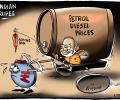
5 commodities namely crude oil, natural gas, petrol, diesel, and aviation turbine fuel (ATF) were kept out of GST's purview given the revenue dependence of state governments on these sectors.

The NCP said that all 3 MVA partners are united in running the coalition government in Maharashtra, but no decision has been taken so far on alliance for the 2024 assembly and Lok Sabha elections.

'While the GST is structured to be an all-encompassing tax and to create a vastly expanded digital network of recorded transactions, no one knows how traders long used to avoiding taxes will apply their ingenuity,' says T N Ninan.
The compensation would be met through levy of a cess called 'GST Compensation Cess' on luxury items and sin goods like tobacco, for the first five years.

Among Sensex firms, Bharat Electronics rose the most by 4.26 per cent. HCL Tech gained 2.57 per cent, Bajaj Finance by 2.19 per cent, TCS by 1.99 per cent, Tech Mahindra by 1.88 per cent and Infosys by 1.85 per cent. Gains in Axis Bank and State Bank of India also supported the rally. However, Mahindra & Mahindra emerged as the biggest loser, falling by 2.47 per cent. Maruti dropped 1.53 per cent and Tata Motors by nearly 1 per cent due to profit-taking. UltraTech, Eternal and Power Grid were also among the laggards.

The Goods and Services Tax (GST) Council, chaired by Union Finance Minister Nirmala Sitharaman, will likely consider on Saturday a GST rate cut for Covid-19 relief essentials and drugs for treating the black fungus disease and might leave the vaccines untouched. The meeting is being held following a report submitted by a Group of Ministers (GoM) to the GST Council on Monday. The GoM, set up by the Council on May 28, was mandated to look at tax exemption and concessions on various Covid items including vaccines, drugs, and equipment.
Floor rate with a narrow band to be fixed.

FM said a Constitution Amendment Bill for introduction of GST will be passed soon.
The Budget assumes significance as it comes on the back of lower-than-expected growth numbers during the second quarter and geopolitical uncertainty.
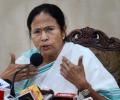
Banerjee asked Modi not to allow "an insufferable blow to the federalist polity of the nation" by depriving the states of the GST compensation. "I am deeply anguished by the Goods and Services Tax imbroglio which tantamounts to a betrayal of the trust and moral responsibility of the Government of India towards the states, violating the very premise of federalism."

Claiming taxes collected from the south were being distributed to north India and that the former were not getting their due share, Congress MP D K Suresh on Thursday said the southern states will be forced to demand for a separate nation if the 'injustice' was not rectified.

The Opposition said that the government was 'bull-dozing'.

The finance minister continues to be backed by the same policy team in charting out the broad strategy as in the few earlier Budgets.

The GST rate for the sector has not yet been finalised by the government.
The shortfall in GST compensation payable to states in the current fiscal is estimated at Rs 2.69 lakh crore, of which Rs 1.58 lakh crore would have to be borrowed this year. The Centre expects to collect over Rs 1.11 lakh crore through cess on luxury, demerit and sin goods which will be given to the states to compensate them for the shortfall in revenue arising out of GST implementation. The remaining Rs 1.58 lakh crore would have to be borrowed to meet the promised compensation to states under the Goods and Services Tax (GST) regime.

The finance ministry has said that the Goods and Services Tax will not apply on room rents of 'sarais' (inns) or properties managed by religious and charitable institutions. The clarification was issued by the Central Board of Indirect Taxes and Customs (CBIC) on Thursday evening to clear the confusion with regard to the levy of GST on room rents. This clarification by the Finance Ministry came following a demand from various quarters including AAP MP Raghav Chadha that the GST on rooms rented by religious institutions be withdrawn.

The GST Council's agenda includes trimming the number of items in the 28 per cent slab by 75 per cent, easier compliance for assessees and small taxpayers, and a presentation on bringing real estate under GST.

Badal, who served as the finance minister in the previous Congress government, said, "Seven years ago, I merged the People's Party of Punjab with your party. I did so with immense hope and an expectation of being integrated into an organisation with a rich history that would allow me to serve both the people of Punjab and its interests to the best of my ability."
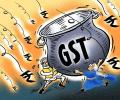
'We have already given Rs 1.59 trillion to states.' 'So, there is no question of giving them more.'

Preparing legal framework to protect states from revenue loss.

GST compensation law allows for imposition of cess on certain luxury goods like tobacco, high-end cars and aereated drinks to create a corpus for compensating states for any loss of revenue in the first five years

For every rupee in the government coffer, 58 paise will come from direct and indirect taxes, 34 paise from borrowings and other liabilities, six paise from non-tax revenue like disinvestment and two paise from non-debt capital receipts, according to the Budget documents for 2023-24.

GST rate for petrol and diesel cars and hybrid vehicles is already at the highest bracket of 28 per cent plus cess.

The GST will be a national sales tax that will be levied on consumption of goods or use of services

Reacting to the announcement, MSME Minister Nitin Gadkari said clearing GST dues within 30 days will be highly beneficial for the MSME sector and will also be instrumental in increasing job opportunities.

Full exemption for all health insurance premiums and reinsurance or a reduction in the GST rate from 18% to 5% on health insurance services is likely.

Heeding to demands made by several states, the GST Council on Friday put on hold a decision to hike the tax rate on textiles to 12 per cent and referred to a panel of state ministers to recommend rate by February, Union Finance Minister Nirmala Sitharaman said. The panel, the highest decision-making body for indirect taxes, met under emergency provisions after states made a request for deferring the tax rate hike on textiles, from the current 5 per cent, to be effective from January 1, 2022. Currently, the tax rate on manmade fibre (MMF) is 18 per cent, MMF yarn 12 per cent, while fabrics are taxed at 5 per cent.
Economic Advisory Council to the Prime Minister (EAC-PM) chairman Bibek Debroy on Tuesday said the government was losing revenue due to the GST, which should be revenue neutral with a single rate. Speaking at an event organised by the Calcutta Chamber of Commerce in Kolkata, he however said that GST has led to a lot of simplification. "The ideal GST is one that has a single rate, and it was meant to be revenue neutral.

Fresh plans of privatisation or divestment in central public sector enterprises and public sector banks might take a back seat this financial year because these may require a large consensus among coalition partners.
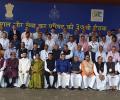
This is a moment when the leaders at the Centre and states must show true leadership for the sake of the country. And it is the top political leaders, not attorney generals or bureaucrats, who should be sitting together and settling this thorny issue of compensation, says Arvind Subramanian, former Chief Economic Adviser to the Government of India.

A 5 per cent GST rate kicked in on Monday on pre-packed and labelled food items such as cereals, pulses and flour weighing less than 25 kg.

Additional solicitor-general says extra-neutral alcohol liable to new tax

'Marathwada is the suicide capital of Maharashtra.' 'To stop such man-made disasters, the government should immediately come up with a rightful package, not this charitable approach to compensation.'
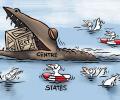
Domestic traders body CAIT on Thursday said that much against the declared spirit of GST as good and simple tax, it has become a "colonial taxation system" not compatible with the ground realities of business in India. Various amendments and introduction of rules under GST in the recent past have made the tax systems system much more complicated and put much compliance burden on the traders, it said in a statement. The Confederation of All India Traders (CAIT) added that it is not alone the centre but largely the state governments are more responsible for distorting the GST taxation system and bringing disparities and anomalies in it which has made it a more complex system and a "big headache" for the traders.

The Empowered Committee of State Finance Ministers got its new chairman on Monday in Jammu and Kashmir's Abdul Rahim Rather.
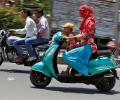
Automobile dealers' body FADA on Thursday sought a cut in GST on two-wheelers from 28 per cent to 18 per cent, saying the segment being essential for millions should not be categorised as luxury item. The industry body said it has appealed to the finance minister, chair of the GST Council, all GST Council members, the ministry of heavy industries, which supervises the automobile sector, and the ministry of road transport & highways. This timely and decisive intervention would help in making two-wheelers more affordable, reviving demand and reinvigorating an industry that has seen a significant slump in sales over the past few years, the Federation of Automobile Dealers Associations (FADA) said in a statement.
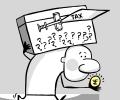
'There are unscrupulous traders who create fake invoices by showing bogus e-way bills, movement of goods.' 'Since the entities registered across different states, and kept on changing their numbers, tracing them was difficult.'

Kerala Finance Minister K N Balagopal has sought systemic changes in the GST structure, saying every state and consumer has lost because of its basically flawed architecture that has also led to rampant revenue leakage for the states. The Goods and Services Tax (GST) regime came into force in July 2017. Even though the framework is focused on having a one-nation-one-tax model, quite a few items, including petroleum products and liquor are still out of the GST purview.
The government will find it difficult to pass the Bill without the Congress's help

Reaching a consensus might also get tougher, as already seen with issues like inclusion of natural gas in GST and imposition of a sugar cess, both central proposals being resisted.
